
Teaching Resource
Children's Stories

CREATIVE MINDS COME TOGETHER
"THERE'S ANOTHER SIDE TO EVERY STORY"


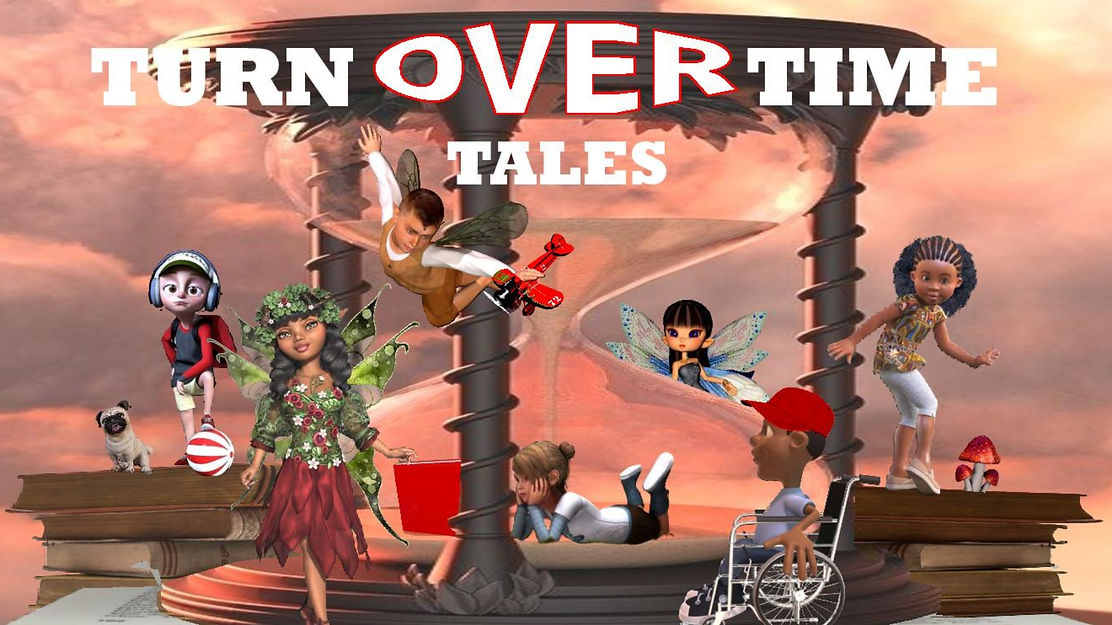
Turn Over Time Tales has videotaped our 3-Dimensional story-skirt experience and illustrated story books just for your preschoolers. Our reversible story skirts combine Fairytale and Bible Stories with academic foundations. Skills such as letter, number, color, and shape recognition, combined with stories that are read aloud, help children develop basic speech and communication skills. Likewise, our illustrated stories teach children the life skills needed to socialize with other learners and make connections between themselves and the characters in the story. But, even before academic introduction begins, preschoolers start learning while
they are playing. Reading and storytelling are play for preschoolers.
Play helps young children explore their surroundings, develop a sense
of identification, observe measurements, and discover the purpose for objects. And, these skills along with their imagination give young
children the tools needed for developing critical thinking.
When we make our videos, we are having as much fun as it looks...
Come play with us.
Jonah and the
Counting Whale

Jonah
Jack and the Purple Beanstalk

Jack
Artist Talk
We had such a good time making these projects. With the exception of extra hot glue and a couple of pieces of felt, we used random pieces of clothing from around our house (don't tell my family)! In the story "Jonah and the Counting Whale" the skin of the whale was made from a women's dress suit. In the story "Jack and the Purple Beanstalk", the gold jewelry on the Giants and eggs for the hen are made from a mailing envelope. And the Giant's dress, pants, and hen's basket are the interfacing from the same women's dress suit in the Jonah Story.

March 20th... World Storytelling Day!!!
FEATURED
STORY

Cynderella

Cynderella is the story of a young girl who is kind and brave. She lived with her loving father near a great kingdom. The father got married for a second time to a selfish woman who had two daughters of her own.
But, one day the father passed away and Cynderella's stepmother forced her to be their maid. Then an announcement came that there would be a great ball at the kingdom because the prince was looking for a wife. Sadly, the Stepmother won't let Cynderella go to the ball, but someone special comes to help her get there.


Curriculum Connection: Cynderella
All About Me
-
Name Recognition
-
My Favorite Things
-
Family
-
Pets
-
Culture
-
Senses
-
Emotions
-
Pairs/Matching
-
Transportation
-
Classroom Jobs: Chores
-
Dressing for the Weather
Creative "All About Me" Questions:
1. If your pet could talk, what would it say?
2. Would you rather move to outer space or the bottom of the ocean? What would you live in?
3. If you could only eat one food for the rest of your
life, what would it be?
4. If you chose your own name, what would it be?
5. Which cartoon character do you wish was real?
6. If you were invisible for a day, what would you do?
Story Discussion
Cynderella

Before the Story
-
What is the difference between real and make believe?
-
What do you already know about this story?
-
What do you think might happen in this story?
-
Why do you think so?
After the Story
-
What words would you use to describe Cynderella?
-
How did Cynderella feel about her stepmother?
-
How many stepsisters did Cynderella have?
-
What was the Grand Fairie's name?
-
What other way could Cynderella get to the ball if she didn't have a carriage?
-
Which stepsister danced with the Prince?
-
Why did Cynderella leave the ball early?
-
How did the stepsisters feel when they were the lasts ones picked to dance with the Prince?
-
Why do people wear masks?
-
What do you know about the King and Queen?
-
What kinds of jobs does the Royal servant do in the castle?
-
How would the story end if the Prince did not find Cynderella’s lost slipper?
-
What kind of material might Cynderella’s silver slipper made of?
-
What do you think happened to the Stepmother and her daughters after Cynderella got married?
-
Can you make up a different ending to this story?
-
If you could give this book another title, what would it be?
-
What three things would you wish for, if you if you were Cynderella?


Reasoning
Skills
Cynderella
What Step is Missing ?
Recipes are process stories.
They develop the skills of sequencing, following directions,
and discovering the results of cause and effect.

"Sue Wee"
The Processing Pig


How To Make Princess Toast

"Tank"
The Tell-a-Turtle
What Happens Next In The Story?
-
Cynderella marries the prince.
-
Cynderella moves out of her father's house.
-
Cynderella moves into the castle.
4. What happens to Cynderella next ?


"Arm-Strong"
The Similarity Squid
How Many Ways Can You Say A Word?
Some words have the same meaning.
Sentence: Cynderella is a kind person.
What other words also mean kind?
nice mean
cool patient
rude peaceful
polite understanding
loving gentle
friendly angry

"Scratchy"
The Reading Racoon
What Word Doesn't Belong?
Reading is breaking apart and manipulating the sounds in a word by understanding the letter-sound relationship.
call
ball
wall
wheel
hall
tall
fall


"Owlivia"
The Observation Owl
Can You Find Things Like This?
Scavenger hunts are one way to make connections between objects and words while playing.
Cynderella rode in a golden carriage to the ball.
How many gold things can you find?


DIY CRAFTS
Flannel Boards are helpful tools for storytelling. Flannel boards are
usually made of a felt fabric. And felt story characters stick to the board easily without need for, glue tape, or pins. Felt can be glued or stapled
to the front of any large square to make a flannel board, such as a cork board, bulletin board, science fair board, or a canvas board. To create
story characters, draw or trace figures onto felt. Draw and color or cut
out figures from magazines and glue felt to the back. Don't forget
scenery, like furniture, tools buildings, landscapes, or animals. In
addition to storytelling, flannel boards are good bulletin boards for
alphabet, number, color, shape, weather, and calendar review.
Learning
Objectives
Storytelling

Develops Imagination
Storytelling ignites the readers capacity to visualize the words they hear, which is an important component to critical thinking. Storytelling allows children to compare and contrast and compare reality and fantasy.
Aids Literacy
and Vocabulary
By listening to stories children learn new words and how they apply to a situation. And, it helps children better understand intangible concepts such as time and relationships. Storytelling also gives children an opportunity to put names to their emotions.
Enhances Listening Skills
Children naturally talk more than they listen because they are learning about themselves and how they fit into their environment. Hearing a story takes them outside of themselves, while they follow the story character's activities and interactions.

